
13 Best Concentration Camps & Holocaust Memorials to Visit in Europe
The Holocaust is a gruesome part of the world’s history, and there are many must-visit Holocaust sites across Europe that have been preserved with the goal of helping future generations learn from what occurred.
The Holocaust was a mass genocide of Jews and other populations that lasted from 1933 to 1945. During the Holocaust, millions of Jews, Poles, political dissidents, and other marginalized groups were imprisoned and brutally murdered by the Nazi regime and its collaborators.
While it is a difficult time in history to recall, it is imperative that we learn from the past, and visiting Holocaust sites is part of that.
They offer us a chance to learn and confront ourselves with hard truths.
I’ve spent more than a decade studying the Holocaust, traveling to visit sites like Auschwitz, Dachau, and the Anne Frank House multiple times.
I can confidently say that visiting these historical sites will change the way you view the world.
Below are some of the most well-preserved and educational Holocaust sites around Europe which are definitely worth your time to visit, including many of the best concentration camps to visit in Europe.


Best Concentration Camps to Visit In Europe
During the rise of the Nazi Third Reich, it is estimated that more than 40,000 concentration camps, death camps, labor camps, and transport camps were established.
Many of these were smaller subcamps, and thus they disappeared once World War II came to an end.
However, many larger camps were preserved for history and learning opportunities, and you can still visit them today.
After visiting numerous concentration camps and other Holocaust sites, these are the best concentration camps to visit in Europe:

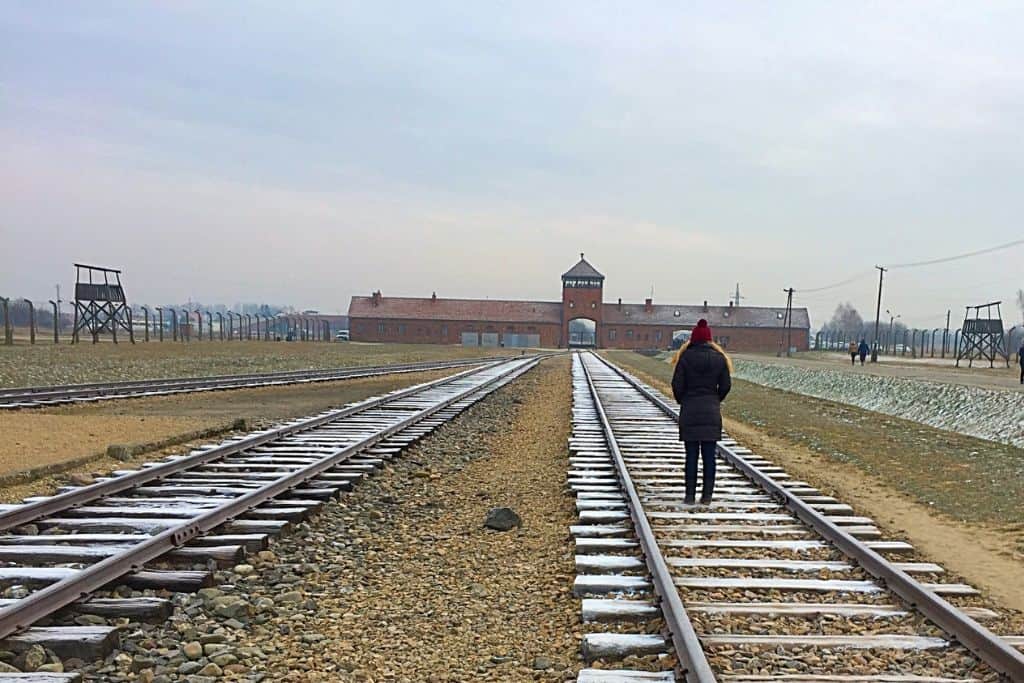
1. Auschwitz Birkenau Concentration Camp and Memorial (Poland)
Auschwitz Birkenau, located in Oświęcim, Poland, is one of the most-visited Holocaust sites in the world and is something you should not miss if you’re traveling to Krakow, Poland.
It remains at the top of this list because seeing Auschwitz is an incredible learning experience. I’ve visited personally three times, and I learn something new each time I am there.
The grounds of Auschwitz I and Auschwitz II-Birkenau are well-preserved, making it one of the best concentration camps to visit.
Auschwitz, the largest Nazi Concentration Camp, was in operation from 1940-1945. It is widely known as the largest death or extermination camp, and, out of the 1.3 million prisoners who walked through its gates, only about 200,000 survived.
During a visit, you’ll be able to tour both camp locations (Auschwitz I and Auschwitz II-Birkenau) and see numerous permanent museum exhibitions, barracks, gas chambers, crematoriums, and guardhouses.
For everything you need to know about planning a visit to Auschwitz, read How to Best Visit Auschwitz.
Visit Auschwitz From: Krakow, Poland
For tickets and additional visiting information: Auschwitz Birkenau Museum and Memorial
Travel Tip: The easiest town to visit Auschwitz Birkenau from is Krakow, Poland.
Since it’s located more than an hour outside the city, book a guided tour to travel easily to the camp site.
2. Dachau: The Best Concentration Camp to Visit in Germany
Dachau, located just outside Munich, Germany, was the first “model” concentration camp for all others. It is the best concentration to camp to visit in Germany, and it is also incredibly easy to reach.
The Bavarian government keeps up with restoration projects around the camp complex, preserving the site as an important piece of German history so that others can remember and learn from it.
Prisoners first entered Dachau in 1933. Originally created for political prisoners, Dachau was never officially classified as a death camp. Meaning, the showers, gas chambers, and crematorium you’ll see here were never used for mass-scale incineration.
The grounds of Dachau are extensive, and there is so much more to learn than is depicted on the plaques around the camp enclosure.
Because of this, I highly recommend you take a guided tour of Dachau. They are affordable and will add so much value and knowledge to your trip.
Visit Dachau From: Munich, Germany
For tickets and additional visiting information: Visit the Dachau State Museum Website.


3. Sachsenhausen Concentration Camp (Germany)
Another one of the best concentration camps to visit in Germany, Sachsenhausen, is located just outside of Berlin and still welcomes visitors today.
The camp site has been divided into thirteen exhibitions, all situated in buildings and specific portions of the camp.
Separate areas exist for information regarding Sachsenhausen’s SS staff and their duties, Jewish prisoners, medical experiments, and many others.
You’ll also find information on a nearby satellite camp, Oranienburg.
While you can reach Sachsenhausen via public transportation, it is about 45 minutes from Berlin.
I recommend booking a tour from the city center in order to save time and guarantee yourself a guide in the camp.
Visit Sachsenhausen From: Berlin, Germany
For tickets and additional visiting information: Gedenkstätte und Museum Sachsenhausen
4. Majdanek Extermination Camp (Poland)
In Lublin, Poland, lie the remains of the Majdanek, now a concentration camp memorial.
Majdanek is far less visited than the other larger camps like Dachau and Auschwitz, but it has made the list of must-visit Holocaust sites because of how much of the area has been preserved. It is definitely one of the best-preserved extermination camps, making it a must-visit Holocaust site in Europe.
Most of the original buildings still stand, including long stretches of barbed wire dotted with guard houses. Rows of barracks stretch far into the distance, helping visitors understand the grotesque, unending feeling of being imprisoned here.
In Majdanek, you can visit gas chambers, a bathhouse, many barracks, monuments, and a visitor’s center museum.
In addition, the Mausoleum is an immense tribute that stands to commemorate the lives lost at Majdanek, beneath which lies ashes from those cremated in the camp.
Majdanek looks eerily similar to the way it did when it was in operation, making it a concentration camp worth your time to visit.
Visit Majdanek From: Lublin or Warsaw, Poland
For tickets and additional visiting information: Majdanek Museum Website

5. Theresienstadt- Terezin (Czechia)
Terezin, known also as Theresienstadt, is a former transport concentration camp outside of Prague in the Czech Republic.
The grounds of the concentration camp were largely set up inside the Terezin Fortress, a walled defense building laid out in the shape of a star.
The Nazis used Terezin as a ghetto and a tool for their propaganda machine.
Famously, this was the concentration camp that received visitors from the Red Cross. Beautification projects were done and a film crew was brought in…all to prove to the world that concentration camps and the Nazi regime weren’t all that bad.
Even today, the film footage from Terezin is haunting.
On a visit to Theresienstadt, you can walk through numerous original camp buildings. Places like showers, an execution yard, and bunks have been preserved and stand almost as they were then.
Many significant works of art came out of Theresienstadt. In fact, the largest collection of children’s artwork from the Holocaust has been preserved from Terezin. Make sure you view the separate museum and the Magdeburg Barracks, where this artwork from Terezin inmates is still displayed.
As far as notoriety goes, this camp is often overlooked, which is a shame. A visit here has so much unique history to share with visitors.
Visit Terezin From: Prague, Czech Republic
For tickets and additional visiting information: Terezin Memorial Website

Other Holocaust Sites to Visit in Europe
There are so many other Holocaust Sites to visit in Europe other than just the grounds of former concentration camp memorials.
Visits to memorials, hiding places, or burial grounds offer just as much knowledge and insight into the Shoah from a different perspective.
6. Anne Frank House (The Netherlands)
Anne Frank is perhaps the most well-known voice from the Holocaust.
Over a million people visit her house in central Amsterdam each year.
During World War II, Anne Frank and her family went into hiding with four other people. They lived in the Secret Annex above her father’s warehouse for more than two years until they were betrayed- by whom, no one knows.
The family was deported to various Nazi concentration camps, and Anne’s father, Otto Frank, was the only member of the Frank family who survived.
After liberation, Otto Frank returned home to Amsterdam where a family friend, Miep Gies, gave him what had been left of Anne’s diary when the family was deported.
Otto Frank eventually published Anne’s diary under the name The Diary of a Young Girl. Ultimately, he decided to clear out the Secret Annex and open it as a museum, hoping to encourage young people to fight against injustice.
Without a doubt, this is one of the top must-visit Holocaust sites in the world.
Walking through the Secret Annex is a surreal experience. I’ve visited many times, and, still, I can’t help but be in awe of the strength and courage that Anne and her family had.
Make sure to get tickets early, as they release on the second Tuesday of each month and always sell out!
Visit the Anne Frank Huis From: Amsterdam, the Netherlands
For tickets and additional visiting information: Anne Frank House
7. Ponar Forest (Lithuania)
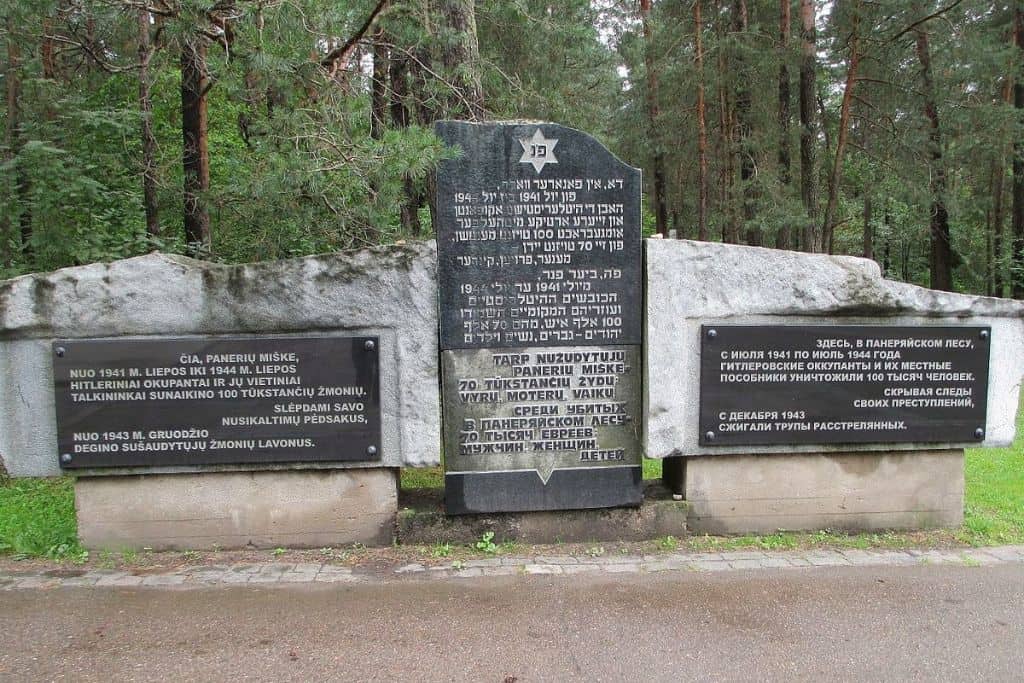
Although a lesser-known Holocaust site, Ponary (also known as Ponar or the Paneriai Memorial Park) is incredibly important and moving and well worth visiting.
Until recently, Ponar was just a forest outside of Vilnius, Lithuania.
Over the past several years, researchers have dug deeper into the history surrounding the forest and have unearthed (literally) artifacts and remnants of what happened there.
The Ponar Forest is a mass execution grave site. Here, an estimated 100,000 Jews and other prisoners were lined up on the edge of a ravine in the forest and brutally murdered, shot to death.
However, it was recently discovered that some prisoners in Ponar found a way to escape. A hand-dug tunnel was excavated in Ponar in 2016. This tunnel began in the holding pit of Ponar and allowed 12 of the Jewish leichencommando unit to escape into the forest.
A visit to Vilnius (Vilna) would not be complete without paying your respects to those murdered in Ponar Forest.
Visit Ponary From: Vilna, Lithuania
For tickets and additional visiting information: There is no official museum, but take a guided tour of the Paneriai Memorial Park and Memorials as well as other Lithuanian sites.
8. Schindler’s Enamelware Factory (Poland)
Oskar Schindler is one of the most well-known rescuers from Holocaust history, thanks, in part, to the fame of the movie Schindler’s List.
Schindler, a Nazi officer, ran a factory in Poland where he worked to save Jews from deportation and death by giving them legitimate jobs and working papers.
You were lucky if your name was found on Schindler’s List.
In all, Oskar Schindler saved the lives of about 1,200 Jews. He has been designated as Righteous Among the Nations, a title reserved for those who actively worked to save Jewish individuals during the Holocaust.
In Krakow, the building where Schindler’s Enamelware Factory was housed still stands. It has since been converted into a museum that covers Polish resistance and the story of Oskar Schindler.
This museum is a must-visit Holocaust site to tour if you are in Krakow, Poland.
Visit Schindler’s Factory From: Krakow, Poland
For tickets and additional visiting information: Museum of Krakow Website

9. Warsaw Ghetto (Poland)
The Warsaw Ghetto was the walled-in section of Warsaw, Poland, where Jews were forced to live during the Holocaust.
Throughout World War II, about 375,000 Jews lived within the confines of the ghetto and were starved, shunned, and murdered.
The conditions within the ghetto were notoriously difficult, and residents were not permitted to leave without special papers or directions.
One of the most popular resistance efforts, the Warsaw Ghetto Uprising, occurred here, where a group of Jews led by Mordechai Anielewicz fought back against their oppressors.
Today, not much of the Warsaw Ghetto and its walls remain. After the uprising, Nazis destroyed the ghetto. However, you can still walk the Warsaw Ghetto Trail.
This trail takes visitors past monuments and locations throughout the city of Warsaw that are pivotal to the Jewish community’s history. As well, you can still see some fragments of the Warsaw Ghetto wall during this tour.
Because the fragments of the ghetto can be difficult to locate, I recommend you take a tour of the Warsaw Ghetto which will guide you past the ghetto wall, surviving streets of the ghetto, the place where the bridge connecting the ghetto was, and the memorials.
Visit the Warsaw Ghetto From: Warsaw, Poland
For tickets and additional visiting information: Take a tour around the ghetto ruins
Must-Visit European Memorials to Victims of the Holocaust
All around the world, memorials commemorate and remember the lives of those who were victims of the Holocaust.
In Europe, many of these memorials are popular.
Visit a few European Holocaust Memorials and spend some time paying your respects.
10. Shoes on the Danube Promenade (Budapest, Hungary)
For some reason, the Shoes on the Danube Promenade is one of the most moving memorials I have visited.
Located on the banks of the Danube River in Budapest, Hungary, these haunting shoes tell the story of those murdered by the Hungarian Arrow Cross Party.
In Budapest, Jews were rounded up and made to stand along the waters of the river. They were told to take off their shoes and were shot, brutally, into the Danube, where their bodies were lost to the waters.
These iron shoes are all different, representing the unique identity of each person. and rest on the banks right where this horrific event happened years ago.
Visit the Shoes on the Danube Promenade From: Budapest, Hungary
For tickets and additional visiting information: Budapest City Website

11. Berlin Holocaust Memorial (Germany)
The Berlin Holocaust Memorial, also known as The Memorial to the Murdered Jews of Europe, is Berlin’s tribute to the Jews murdered in the Holocaust.
This is perhaps the most unique memorial to Holocaust victims in Europe, simply because of its artistic design.
The Berlin Holocaust Memorial is made up of more than 2,500 concrete slabs that stand upright at different heights. Through the slabs run cobblestone pathways that allow visitors to weave their way through the site with no particular direction.
What visitors will quickly notice is that there are no names, dates, or symbols on any of these markers.
The artist who designed The Memorial to the Murdered Jews of Europe wanted visitors to understand the vast, nameless, unending feeling that Jews may have encountered during the Holocaust.
What many don’t know is that there is a visitor’s center beneath the memorial. This museum tells the stories of those murdered and helps visitors remember that each person lost in the Holocaust was a unique person.
Visit The Berlin Holocaust Memorial From: Berlin, Germany
For tickets and additional visiting information: Berlin City Website
Best Holocaust Museums To Visit
Along with memorials and Holocaust sites, visiting Holocaust Museums is also worthwhile.
While there are many must-visit Holocaust Museums throughout the world, I’ve listed the two foremost below.
Both are enormously informative and have multiple exhibitions, projects, and educational initiatives happening all the time.
12. Yad Vashem (Israel)
Yad Vashem, which stands on the Mount of Remembrance in Jerusalem, is Israel’s tribute and memorial to the victims of the Holocaust.
This museum aims to preserve survivor testimony and collect artifacts and stands firm in its belief that everyone remembers and learns from the Holocaust.
Yad Vashem is open to visitors.
Most who come to the site head to the Holocaust History Museum, the largest part of the museum. However, the Museum of Holocaust Art, rotating temporary exhibits, and synagogue are also open to the public.
One of the things you don’t want to miss at Yad Vashem is the Garden of the Righteous Among the Nations.
Non-Jewish Holocaust rescuers are honored here. You can search for the trees or inscriptions that honor people like Oskar Schindler and thousands of other rescuers during the Holocaust.
Visit Yad Vashem From: Jerusalem, Israel
For tickets and additional visiting information: Yad Vashem Website

13. United States Holocaust Memorial Museum (Washington, DC, United States)
The United States Holocaust Memorial Museum (USHMM) is widely known as the foremost Holocaust museum in the world, aside from Yad Vashem.
Nestled in the museum district of Washington, D.C., this exhibition stands as both a museum and a memorial to those murdered during the Holocaust.
The four-floor, winding, permanent exhibition draws visitors into a chronological timeline of the events and facts surrounding the Holocaust.
Thousands of artifacts tell the stories of prisoners, and first-hand survivor accounts really add a unique touch to the museum overall.
In addition, rotating temporary exhibitions and educational series offer insight into varying topics such as the idea of neighbors during the Holocaust and what part Americans played in the Holocaust.
During a visit, you can even meet Holocaust survivors, as many volunteer at the “Survivor’s Desk” in the museum atrium.
The USHMM is free to visit, but you do have to reserve tickets in advance. Tickets often sell out, so be sure to grab them well ahead of time here!
Visit The United States Holocaust Memorial Museum From: Washington, D.C.
For tickets and additional visiting information: USHMM Website
FAQ: Must-Visit Holocaust Sites in Europe
Here are answers to some of the most frequently asked questions I get in relation to Holocaust sites in Europe:
Which Concentration Camp is Best to Visit?
Auschwitz is the best concentration camp to visit in Europe and is the first concentration camp you should visit if you’re looking to learn about the Holocaust.
The exhibition portions are incredibly informative, and there are so many different displays to view.
Here, you’ll be able to learn a lot of background knowledge about the Holocaust in addition to learning about the Nazi death camp of Auschwitz.
A visit to Auschwitz puts the Holocaust into perspective, and, just by sheer size, you’ll be stunned.
What is the best concentration camp to visit in Germany?
If you are only going to visit one concentration camp in Germany, visit Dachau. It is well-preserved, easy to get to, and is unique. It is a good entry point into learning about the Holocaust.
Why you should visit a concentration camp?
Visiting a concentration camp is a way to learn from the horrors of the Holocaust; there is nothing quite as impactful as hearing stories from history as you’re walking the grounds of a concentration camp.
While visiting a concentration camp is undoubtedly difficult, it is also a sobering and moving experience that is worthwhile.
Tips For Visiting Concentration Camps in Europe
Visiting a Nazi concentration camp is difficult, and it can be somewhat scary. There are a lot of unknowns, and it is a strange experience.
Below are a few tips to help you best prepare for a visit to a concentration camp.
Should You Take Children to Visit a Concentration Camp?
Most concentration camps recommend that visitors under the age of 12 not attend.
However, you are the parent.
I would caution bringing young children. As an educator and someone who has studied the Holocaust deeply, I can confidently say that it can be difficult for children, and even adolescents, to understand the complexities of the Holocaust.
If you choose to bring your children to a concentration camp, preview what you’ll see ahead of time and educate yourself on what happened.
Give your children context before you show up, and perhaps avoid certain areas of the camps that may be triggering, such as the crematorium.
Dress for the Weather
Most concentration camps are almost entirely exposed to the elements.
The majority of your tour will take place outside, regardless of what area or camp you are visiting.
Make sure to dress for the weather in Europe! You don’t want to miss important information because you’re too cold or hot!

Be Aware of How Emotionally Taxing Holocaust Sites Can Be
When you visit a Holocaust site, nothing, and I mean NOTHING, is sugar-coated.
You will view graphic images, you will read heartbreaking stories, and you will see things you can’t unsee.
This can be incredibly devastating and emotionally taxing.
Don’t be afraid to cut your visit short if you become overwhelmed, and make sure to have open time for conversation and reflection following your visit.
Take Guided Tours
Almost all concentration camp grounds are free to enter.
However, in visiting many of them, I’ve found that going on guided tours is the best way to learn.
With a guided tour, you have the benefit of having a personal guide dedicated just to your group. You get commentary others don’t, and you can ask questions.
While signposts and other informational things around the camps are generally very helpful, I’ve found that you get much more information if you participate in guided tours.
Conclusion: Must-Visit Holocaust Sites in Europe
The history of World War II and the Holocaust cannot be forgotten.
One of the best ways to study history and learn is by walking in the places where this history happened.
Although visiting a Holocaust historical site is a difficult, emotional experience, it is important that we keep visiting them.
There are hundreds of Holocaust sites around the world, but these are some of the top places to visit where you can learn a lot and still find preserved memories and tributes.

↳ Read Other Helpful Holocaust Travel Content Below!
✔ These are the Top Holocaust Sites to Visit Around the World!
✔ Traveling Around Europe? Don’t Miss these Holocaust Tours
✔ Full Guide to Visiting Auschwitz-Birkenau Concentration Camp
or Dachau Concentration Camp
✔ Here are the Best Auschwitz Tours to Take From Krakow!
✔ Everything You Need to Know About Visiting the Anne Frank House
✔ Make sure you have the best travel items for a trip abroad!


