
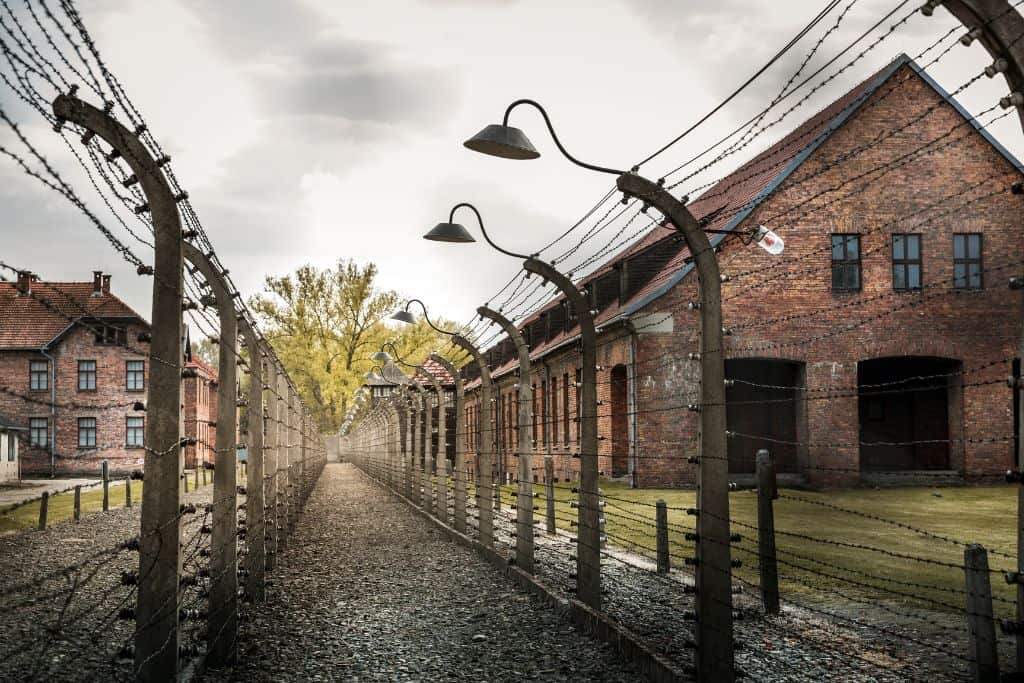
11 Important Things to Know Before Visiting a Concentration Camp For the First Time
VISITING A NAZI CONCENTRATION CAMP FOR THE FIRST TIME CAN BE OVERWHELMING.
And, if you’re thinking about visiting a concentration camp on your next trip to Europe, chances are you might be a little bit worried about what you’re exactly you’re going to encounter while you’re there. After all, visiting a concentration camp is not at all like visiting the Eiffel Tower or another tourist attraction.
The grounds of places like Auschwitz are marred with despair and the largest evils of humanity. Plagued with things we can’t even comprehend today.
What will I see? How will I feel? How do I act? What if it’s too much for me?
I vividly remember the first time I visited Auschwitz concentration camp in Poland. I spent the whole morning pacing, wondering if I could handle what I was about to see.
I had studied the Holocaust for years by then, but it was the first time I’d walk where these people walked years before me- and I was terrified.
As a Holocaust educator, I’ve visited quite a few Nazi concentration camp sites since that first; this post draws on my experience visiting camps for over a decade and will tell you all you need to know about both the practical and mental things you should know before you visit a Concentration camp for the first time.
How to Mentally Prepare Yourself For Visiting a Nazi Concentration Camp
First, it’s necessary to put out there that you really can’t fully prepare yourself for what you’ll experience when you first visit a concentration camp. Whether it’s a larger camp complex like Auschwitz, or a lesser-known one like Plaszow, the horror, terror, and sheer grief is palpable.

1. It Will Be Difficult
There is no way to beat around this bush. It will be difficult to visit the grounds of a concentration camp. The entire experience is like a weight on your chest that you can’t quite seem to get rid of.
All of a sudden, a place that you’ve known about becomes real in a way you didn’t anticipate. Now, you can picture it, you know stories of people who were murdered there, and you’ve seen countless artifacts.
Deciding to visit a concentration camp is not a leisurely afternoon activity. It is a commitment to learning from history so that we do not repeat it. Unfortunately, a lot of that history is barbaric, making a visit to a place like Auschwitz categorically difficult.
2. You Will Not Be Able to Fit It All In One Day
Even after visiting some concentration camps multiple times, I still have not been able to fit everything into a day…even once. Why?
There’s just too much.
There’s too much to see, too much to process, and too much to learn. It is imperative that you go into this experience understanding that you are looking at decades of research and learning.
It would be impractical to expect that you could digest everything at these sites in one day.


3. It Will Be Overwhelming
No matter how many times I walk around Auschwitz or Dachau, I find myself incredibly overwhelmed by the end.
For some, it will be sensory overload. To feel the wind in the open air, to smell the wooden bunks in the old barracks, to hear footage from old videos…it’s almost too much.
For others, myself included, I find that I reach a threshold of sheer mental overload from information.
It is instinctual to want to soak everything in and learn as much as you can. But be gracious with yourself.
In most camp complexes, there is the actual tour around the grounds followed up with a walk through museum exhibits. By the time you’ve seen things, read plaques, and have made your way through the museum…it’s a lot.
That’s OKAY. I have literally never read the information in the last two exhibits at Dachau Concentration Camp even though I’ve toured it plenty of times. By the time I get there on the back end of the tour… I just can’t.
Visiting a concentration camp is overwhelming. Don’t push it to be more than it already is.
4. You Will See Very Graphic Things
If you didn’t know by now (seriously?), the footage and photos from the Holocaust are incredibly graphic.
Like, almost beyond human perception, graphic.
And the grounds of former concentration camps are meant to be memorials and museums to this history. They aren’t going to pull any punches.
Know going in that you will see things that make you uncomfortable.
For me, it was the hair at Auschwitz (yes, literally piles of human hair) and the children’s clothing. For you, it might be a photo.
Thankfully, there is generally a lot of room to walk past some of these more graphic exhibits if you’re unable to process them visually.


5. The Smells Might Surprise You
One thing I was not prepared for before I visited a concentration camp for the first time was the smell.
No, there is no stench of decay or disease lingering. But there are distinct smells that will stay with you.
For instance, the barracks at Auschwitz have a wooden smell that permeates the senses. Similarly, in Dachau, there is a distinct smell that registers when you’re standing in the crematorium room.
There’s something wildly unsettling about this- I knew I’d see the camp. I knew I’d hear footage. I knew I could touch some artifacts…but I was not ready to smell the Holocaust.
6. You Can Feel The Despair
There is a heaviness- a reverence- that is tangible in the air when you step foot onto the grounds of a former Nazi concentration camp.
Often, I notice it as soon as I walk under the entrance gates.
It’s almost as if walking through that gate triggers the idea that I will be able to leave but others who came before me (not all that long ago) could not.
The despair is heavy. It is almost suffocating.
Practical Things to Know Before Visiting a Concentration Camp
A large part of visiting a Holocaust site is definitely being mentally prepared for it. But one thing I didn’t realize ahead of time was that there is also a need to be physically prepared for it as well.
Here are a few practical things I always recommend people take into consideration before they visit a Nazi concentration camp:

7. Dress for the Weather
If you weren’t aware, many of the camp complexes were very large. As such, a lot of the grounds are outside and exposed to the elements.
For much of your visit, regardless of which camp you are visiting, you’ll be outside. Dress for the weather.
At times, you’ll walk into a museum exhibit, a standing barrack or crematorium, or other building, but it is not often and it is not for long.
It seems wrong to complain about the cold of Auschwitz when prisoners were wearing much less than we are, but you should prepare, pack, and dress for the weather- and Polish winter winds are no joke.
Similarly, dress for summer weather, if appropriate.
8. Wear Closed-Toed Shoes
For the love of God, please wear closed-toed shoes when you visit a concentration camp.
I made the mistake of wearing sandals the first time- no.
Almost the entirety of the grounds in the camp complexes are packed dirt. The rest of it (though not much) is grass or rocks.
You will be dirty, tired, and inconvenienced if you choose to wear shoes that are not appropriate for walking on uneven ground.


9. Learn About the Holocaust History Beforehand
It is well worth it to make sure that you have a bit of background knowledge on the Holocaust and World War II before you decide to see a camp complex.
Knowing what happened, even in the most general of aspects, will help you place this piece of history into perspective much better.
In the same way I’d never suggest someone visit the Anne Frank House before reading her diary, I would never suggest someone visit a camp like Majdanek without knowing at least a little bit about what happened there.
Some tours (including many tours that depart to Auschwitz from Krakow) show Holocaust documentary films on the way to the camp site, which can help shed light on the history somewhat.
You certainly don’t have to be an expert, but know something!
10. Read Personal Stories From the Camps
I found that reading personal stories from the camps really helped me see the human side of the Holocaust.
It is easy to allow the number of 12 million people to become just blank faces in our memory.
If you read personal stories ahead of time, your visit becomes associated with these stories. Suddenly, you know the story of a person who came before and experienced life here. You recall things they saw or wrote about.
It is incredibly powerful.
I am on a mission to make sure that the people of the Holocaust are remembered. They all have stories, and the more we learn about them, the more we protect that history.


11. Book a Guided Tour So That You Can Focus on the Content
One thing that people don’t account for when visiting a concentration camp is that it can be difficult to know what path to take around the grounds.
As I mentioned before, they are quite large.
Taking a guided tour of a Holocaust site eliminates the need to obsessively check a map and make sure you’ve seen what you want to see.
Instead, a guide will walk you through the camp, sharing stories and information about the various areas. Often, I’ve found that guided tours help to put things in a logical order, too.
For instance, the guided tours I’ve experienced at Dachau begin with the gates and train platform, visit the main square, the barracks, and finally the fencing and crematorium before circling back around to the museum exhibits.
If you weren’t on a tour, you’d likely walk straight ahead, running into the museum exhibits first and missing the entirety of the restored buildings and grounds.
Why Visit a Nazi Concentration Camp?
Visiting a Holocaust site is not for the faint of heart, and it can certainly seem like a “downer” when so much of Europe is touted as the glitz and glamour of Old Town streets and delicious food.
So, why bother visiting one?
You Will Learn A Lot
You can expect to walk away from an experience like this learning an incredible amount.
Everywhere you look, you’ll find information, stories, first-person accounts, and living artifacts educating you on what happened on these hallowed grounds.
The reality is that there is something significant about learning this history in the place where it happened.
It elevates the learning experience to truly be something impactful and memorable.
“Never Again”
The phrase “Never Again” has repeatedly been used as a way to vow that the history of the Holocaust never repeats itself.
It is a slogan used often by survivors, at museums, and in educational aspects.
But in order for Never Again to really be “NEVER AGAIN,” we have to learn what did once happen.
It is one thing to read about the Holocaust and say Never Again. It is another thing to see the expanse of the barracks at Auschwitz and vow…Never Again.

Historical Importance
There is much of historical importance to be gained when visiting a concentration camp, too.
World War II and the Holocaust are often skipped over in history classes, but this time period brings to light so many of our most frightening questions about the state of humanity.
It is necessary to ask ourselves the questions of how humans did these things, or recognize just how long ago this happened (Spoiler: not THAT long ago).
We must come to grips with the fact that places like Dachau are…steps away from homes and town centers where people undoubtedly knew what was happening.
These, along with many other questions and lessons, are important to learn during a visit.
What Concentration Camps Are Worth Visiting?
There are so many former camp complexes around the world worth visiting. Here are three of the most popular camps to visit if you’re looking for a place to start:
Auschwitz Birkenau Concentration Camp
Most people, even those who are unfamiliar with the Holocaust, have heard of Auschwitz.
Just outside of Krakow, this is the first Nazi concentration camp worth visiting. The preservation and museum teams at Auschwitz have done a phenomenal job restoring the property.
In addition, their museum exhibits are so well-researched and easy to understand.
⭐Here are the top guided Auschwitz tours that I recommend
Dachau
Dachau Concentration Camp, located in Munich, is another camp that is worth your time.
It was the first camp ever constructed- meant to be a “model” for others. Although not as well-known as Auschwitz, it’s easily tacked on to a Germany itinerary and has so many unique stories and perspectives to share.
⭐ If you’re visiting Dachau, read the run-down of my most recommended tours here!

Terezin
Terezin is a lesser-known camp complex located outside of Prague.
What makes Terezin (or Theresienstadt) worth visiting is that this camp was used as a propaganda piece for the Third Reich. Organizations like the Red Cross came in, and the Nazis convinced them that these camps weren’t “All that bad.”
As such, many children were at Terezin, and there is a trove of artwork and other things that have survived, which isn’t the case with other camps.
FAQ: What to Know Before Visiting a Concentration Camp the First Time
It is natural that you’d have some questions before visiting a concentration camp for the first time:
What is it like to visit Auschwitz today?
Visiting Auschwitz is a haunting experience. It is heavy and somber, but it is a learning experience you’ll never forget.
It can definitely be overwhelming, so I recommend visiting with a guide to make the most of your time there.

What should I keep in mind when visiting a Holocaust Concentration camp?
The grounds of these camps are memorials and thousands of people perished where you will be walking. Enter the site with reverence and respect and remember that this is not a tourist attraction you’re visiting for fun.
What is it like to visit a Nazi concentration camp?
It kind of feels like a weight crushing your chest that you can just breathe through. It’s an uncomfortable feeling that really brings with it difficult thoughts and realities to comprehend.
You’ll leave a camp complex feeling drained and recognizing the worst in humanity, but as you process, you’ll recognize the importance of visiting these sites to see for yourself what occurred there.
Conclusion: Visiting a Concentration Camp
All in all, it’s important that you be prepared to visit a concentration camp. It’s not something to take on lightly without thought.
I don’t say all of this to scare you, but rather to implore you to take seriously the act of learning from history in the place where it happened.
It won’t be a carefree visit that fills you joy when you think of it years later, but it will be a moving time that you recall as impactful and worthwhile- at least for me it has been.


